

How Safe Is Flight Training? A Practical Guide for Students and Parents
Safe flying begins long before the aircraft leaves the ground.
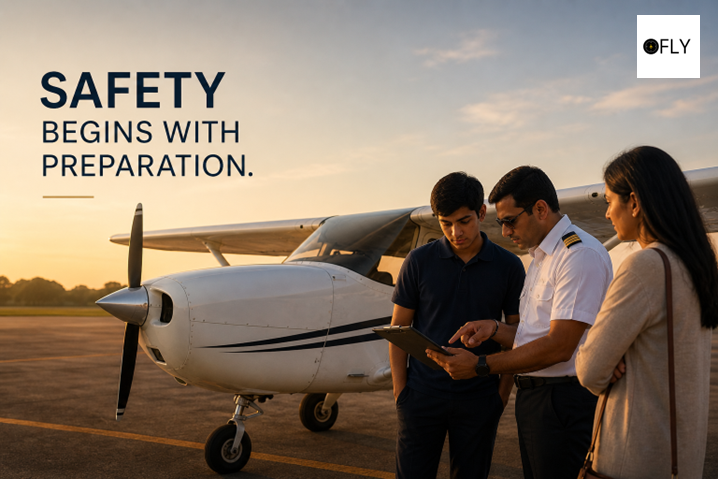
For many parents, the idea of their child learning to fly brings a natural question:
“How safe is flight training?”
It is a valid concern. Aviation, by its nature, operates in an environment that is dynamic and unforgiving. At the same time, it is also one of the most structured, process-driven, and safety-focused industries in the world. Understanding flight training requires moving beyond assumptions both optimistic and fearful and looking at how safety is actually built into the system. This article aims to provide a clear, realistic perspective on how flight training works, what makes it safe, and where caution is required.
Flight Training: What It Really Involves
Flight training is not just about flying an aircraft. It is a combination of structured ground learning and supervised flying, progressing in clearly defined stages. A typical pathway includes:
Ground training (theory and concepts)
Dual flying (with an instructor)
Gradual skill development
Solo flying only after readiness
Training is designed to move from understanding → application → independent capability.
It is not an activity, it is a structured learning process.
Safety in Aviation: A System, Not an Assumption
One of the biggest misconceptions is that aviation safety is based on confidence or skill alone. In reality:
Safety in aviation is built through systems, not assumptions.
These systems include:
Standard operating procedures
Regulatory oversight
Training structures
Maintenance protocols
Instructor supervision
Each layer exists to reduce risk, not eliminate it entirely, but manage it effectively.
Ground Training: The Foundation of Safe Flying
Before a student flies an aircraft independently, they are trained to understand:
How an aircraft works
Weather patterns and their impact
Navigation and airspace
Aviation regulations
Emergency procedures
This theoretical foundation is critical.
A student who understands aviation is far safer than one who only experiences it.
Many risks in aviation are mitigated before take-off, through knowledge and preparation.
Flying Training: Structured and Supervised
Flying training is progressive and controlled. Students do not begin flying independently.
They start with:
Instructor-led flights
Demonstrations of procedures
Repetition under supervision
Solo flying is permitted only when the instructor is confident in the student’s:
Skill level
Decision-making ability
Situational awareness
Students are not rushed into independence. They are prepared for it.
Standard Operating Procedures (SOPs)
One of the defining features of aviation safety is the use of Standard Operating Procedures (SOPs). These include:
Pre-flight checklists
Aircraft inspections
Communication protocols
Defined responses to situations
SOPs reduce reliance on memory and emotion.
In aviation, routine creates safety.
When followed consistently, these procedures significantly reduce the likelihood of error.
The Role of Instructors
Instructors are central to flight training safety. They are responsible for:
inspiring respect for the aviation fraternity & nature
Teaching concepts and procedures
Monitoring student performance
Taking control when required
Deciding when a student is ready for progression
A good instructor brings Experience, Judgment and Calm decision-making. For parents, understanding the quality and stability of instructors at a flight school is as important as any other factor.
Aircraft Age vs Maintenance: A Common Misunderstanding
A frequent concern is the age of training aircraft. It is important to clarify:
In aviation, maintenance matters more than age.
Training aircraft are maintained under strict regulatory standards, including scheduled inspections, component checks and replacements and airworthiness certifications. An older aircraft that is properly maintained can be as safe as a newer one. The focus should always be on maintenance quality, compliance with regulations and operational discipline.
The Role of Mindset and Attitude
While systems and procedures are essential, one factor consistently influences safety:
Human attitude.
Safe flying requires discipline, respect for procedures, willingness to follow structure, avoidance of shortcuts and the like.
Aviation is unforgiving of a casual approach.
Students who treat training seriously tend to progress safely. Those who prioritise speed or convenience over discipline introduce unnecessary risk.
Why Do Incidents Happen?
To understand safety, it is important to acknowledge that incidents, though rare, can occur.
Common contributing factors include:
1. Human Factors:
Careless and/or overconfidence often lead to unwanted situations and sometimes result in incidents. Rushing through training is also a cause where race to meet the requirement become focus then safe practices. Poor decision-making may happen for multiple reasons inclduing lack concepts, poor visualization, improper SoP compliance and more.
2. Weak Adherence to Procedures
While SoP are present for all phases and scenarios, an attitude to skip checklists and ignoring standard protocols bring risk much closer.
3. Training Pressure
Often institute and/or student emphasis on completing training faster lead to unwanted situations. Inadequate time for learning and reinforcement has its own repurcussions.
4. Maintenance or Operational Lapses
Another attitude driven practice is maintenance or operational lapses. Country to country the situation changes on this. They are rare in some countries and relatively common in some. Maintainence lapses happen due to practices followed at flight school or technical team level.
Most aviation incidents are not caused by lack of knowledge, rather by deviation from discipline.
Why Quality Matters More Than Speed
In recent years, there has been a growing focus on faster completion of pilot training. While efficiency is important, it must not come at the cost of understanding.
In aviation, speed is never a substitute for safety.
Quality training includes time for repetition, instructor continuity and depth of understanding. A well-trained student is not defined by how quickly they finish. Rather by how well they are prepared.
What Parents Should Evaluate?
For parents considering flight training for their child, a few key questions can make a significant difference:
Is the training structured and clearly defined?
What is the experience level of instructors?
How stable is the training environment?
Is there a focus on discipline and procedure?
Is the approach balanced, or overly speed-driven?
These factors provide a clearer picture than marketing claims.
The Role of Early Exposure
Before committing to full flight training, it is valuable for students to:
Understand how aviation works
Experience structured exposure
Evaluate their own interest realistically
This helps avoid misaligned expectations, premature decisions and unnecessary financial commitment. At OFLY, the emphasis is on:
Understanding aviation before committing to it.
Conclusion
Flight training is safe when approached correctly. Not because it is risk-free but because it is:
Supervised - Process-driven - Built on discipline
For parents, the focus should be on ensuring that:
The environment, the training approach, and the mindset are aligned with safety.
Aviation rewards those who respect its power. When approached with the right preparation, it can be one of the most disciplined and well-managed learning environments a student can experience.


